

ZIP System sheathing and tape is for framing crews who want the air and water barrier on the wall or roof panel instead of a separate wrap. The panel face carries a water-resistant layer, and taping the seams closes it into one continuous barrier. That replaces housewrap on walls and felt on roofs, saves the crew a trip around the building, and gets the house dried in sooner, which counts for a lot when a Montana framing season is racing the first snow. The part that sells it at the counter is the tape: ZIP System flashing tape goes on down to 0°F, so seams still get sealed on a frosty October morning.
ZIP System is a brand of Huber Engineered Woods. In the early 2000s the company set out to develop a new approach to building envelopes, and ZIP System created the integrated sheathing category. Huber, founded in 1883, is one of the largest family-owned companies based in the US, and its businesses make products for a broad range of uses, including building materials.
What the taped panel replaces
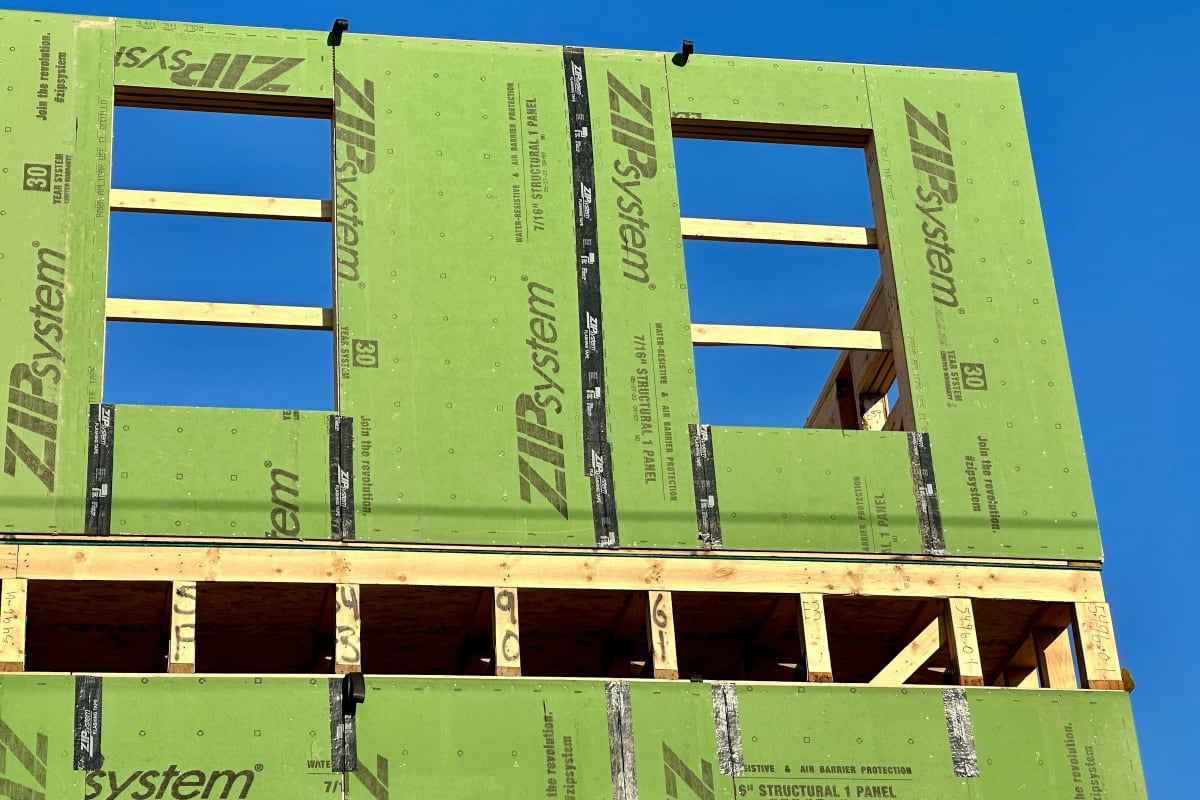
Every ZIP System panel has a water-resistant layer on its face, so the seams are the weak spots. Once they’re taped, the sheathing and tape form one continuous air and water barrier, and that’s why the system replaces housewrap and felt. With the barrier built into the panel, the crew skips a trip around the building with wrap.
Most crews on their first ZIP job doubt that a strip of tape on the seams can stand in for wrap and felt. The answer is the continuous barrier. The panel face is already the water barrier, and the tape seals the seams, where water would otherwise get in. The flashing tape passes AAMA 711, and its acrylic adhesive bonds tightly and seals, even around fasteners. On a roof deck, the taped seams and the built-in barrier help keep water out of the house even if the roof coverings blow off in a storm.
Taping seams with ZIP System flashing tape
ZIP System flashing tape does two jobs: it seals the panel seams and it flashes the openings. Tape the seams soon after the panels go up, because wet panel edges swell and warp. Sweep off the sawdust first, since the tape needs a smooth, clean surface to bond to.
The flashing tape comes in a 3-3/4 inch roll for seams and a wider 6-inch roll, and the ZIP System tape dispenser keeps the roll in hand and off the ground while you work. Break the tape into 3 to 4 foot pieces, and peel the backer as you move along the seam so the tape lies flat. A crooked piece can be pulled up and reapplied while you’re setting it. Keep at least 1 inch of tape in contact with the panel face.
Then roll every piece. ZIP tape uses a pressure-activated acrylic adhesive, so the bond comes from pressure, and a roller is what applies enough of it. The ZIP System tape roller leaves a Z impression once the adhesive is activated, so you can walk the wall and see which tape still needs rolling. Unrolled tape is the most common way crews break the seal. Where a run has wrinkled badly, cut that section away and re-tape the seam.
The flashing tape carries a 30-year limited warranty and a 180-day Exposure Guarantee when it’s used with ZIP System sheathing. For a crew that keeps nails flush and rolls every piece, that is the whole weather barrier finished in one pass with the sheathing.
Nails, shiners and corners
Keep every nail flush so the tape has a smooth surface to bond to. If the gun overdrives, put a flush-mount collar on the nose or lower the pressure with an in-line regulator. Hit the studs, because missing too many with any structural panel reduces the composite action between frame and sheathing and weakens the wall. Drive shiners back out and seal them with ZIP System tape on the outside so the panel’s built-in membrane stays intact.
In a corner, set the tape, push it in with a plastic speed square, then roll it. At an outside corner, run one sheathing edge long enough to cover the exposed end of the panel on the adjacent wall. Keep fasteners flush around every taped detail, and shingle-lap the tape wherever you can, with the upper piece over the lower.
The rest of the ZIP System line
ZIP System wall panels come in 7/16”, 1/2” and 5/8”. The line includes R-sheathing panels, which have foam on a base panel, and roof sheathing. Stretch tape covers an entire rough opening with only a few pieces, and on an entry door, protecting the rough opening is the most important step. Liquid flash also works for inside corners, multi-purpose tape handles general jobsite sealing against air and water, and the line also includes a tape roller and a tape dispenser.
Tape specs
| Product | Roll size | Lowest application temperature | Adhesive |
|---|---|---|---|
| ZIP System Flashing Tape | 3-3/4” x 90’ | 0°F | Acrylic |
| ZIP System Multi-Purpose Tape | 2” x 50’, 2” x 75’ | 0°F | Acrylic |
Frequently Asked Questions
What is ZIP System sheathing?
It’s a structural OSB panel with a water-resistant layer built into its face. The panels are warranted to meet the PS2 voluntary product standard for oriented strand board and not to delaminate, so you get the structural sheathing and the weather barrier in one sheet. That’s why the seam tape matters as much as the nailing.
How do you install ZIP System sheathing?
Hang it like any structural panel, nailing into the studs, then tape and roll every seam. Once the seams are taped, the wall is dried in, so the weather stays off the framing sooner. Install it to Huber’s instructions, because the wall warranty requires it.
Can you use ZIP System on a roof?
Yes. ZIP System makes roof sheathing that’s separate from its 7/16”, 1/2” and 5/8” wall panels, and once the seams are taped it gives you a sealed roof deck with no felt underneath. Tape and roll the roof seams at least as carefully as the wall seams, because a roof deck takes more water than any wall.
What is ZIP System liquid flash used for?
It seals panel seams, either by itself or together with flashing tape, and a seam sealed that way still counts as part of a ZIP System Assembly. It’s the easier choice at inside corners and other spots where you’d otherwise have to force tape into the angle.
What is ZIP System R-sheathing?
It’s a ZIP wall panel with foam on a base panel, so the foam goes up with the sheathing in one step. You seal its seams with flashing tape or liquid flash, the same as the plain wall panels. Under the wall warranty, foam separating from the base panel doesn’t count as delamination, so handle the panels carefully on the pile and at the saw.
Ready to Get Started?
Our building materials specialists can help you find the right Zip System products for your project.