

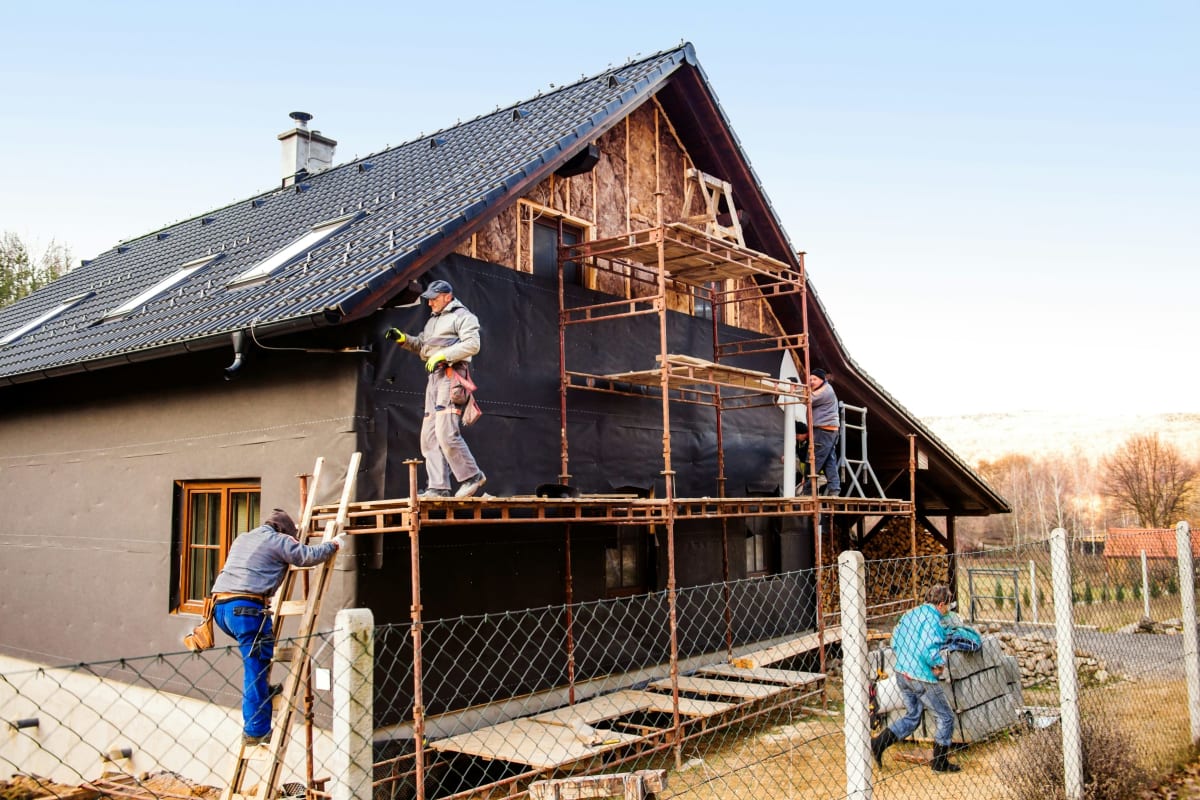
Typar house wrap and flashing tape go on the walls and around the windows before the siding does. BuildingWrap keeps outside water out and lets moisture inside the wall escape. The wraps, butyl flashing and tapes are made to work as one system, for builders wrapping single-family homes and buildings up to three stories.
TYPAR is a trademark of Magnera Corporation or one of its affiliates, and Magnera manufactures TYPAR construction products, including the TYPAR Weather Protection System. Magnera runs 45 production facilities with over 8,500 employees worldwide. TYPAR says its business unit is fully vertically integrated, with local North American manufacturing. The Weather Protection System is a lineup of building wraps, flashings, construction tapes and accessories designed to work together.
Which wrap goes on the building
BuildingWrap is made for single-family homes and structures up to three stories. It sheds rain from the outside and lets moisture from inside the wall get out, which is the whole job of a house wrap. It also handles harsh chemicals and jobsite cleaning, so masons washing down brick next to it won’t hurt it. When the siding crew runs late, the wrap can sit exposed for up to six months with no UV degradation; get the siding on before that window closes. For a building four stories or taller, TYPAR’s commercial product is the one designed for the job.
Hanging the wrap
Start at a bottom corner, run the wrap horizontally, and let it hang past the sill plate so it covers that joint. Every course above laps over the one below it, like shingles, so water always runs down the face of the wrap. Fasten with cap fasteners, then tape every seam with TYPAR Construction Tape, which has been tested for compatibility with the complete TYPAR Weather Protection System. Roll the tape down hard; a seam tacked only at the edges lifts in the first good wind.
At each window, cut the wrap so the sides and sill fold into the opening, and flip the head flap up and tape it out of the way until the flashing is on. The most common mistake is tucking the wrap behind the head flashing, which sends water running off the wrap straight into the wall. The wrap always goes over the head flashing. TYPAR also publishes its BuildingWrap Installation Guide in Spanish.

Flashing windows, doors and corners
TYPAR Butyl Flashing is the everyday window flashing. It has no VOCs, and it works with most caulks and sealants used to set windows. A 6- or 9-inch roll covers a standard window. Go sill first, then jambs, then head, and bring the head flap of the wrap down over the top. It passes ASTM D1970 nail sealability, so it closes around the shank where the fin nails punch through.
Window work often runs into cold weather, and that’s when the doubt about adhesion comes up. TYPAR Butyl Flashing is rated from 30°F, and it passes ASTM D3330 cold temperature pliability testing. At 30°F and above it goes on, stays pliable and grabs; below that, wait for the afternoon warm-up. Keep the rolls in a heated cab, and apply it only to dry sheathing with no frost on it, because frost on the OSB ruins adhesion faster than cold air does.
Inside and outside corners are where siding installation is most likely to damage the wrap. The 18-inch Butyl Transition Flashing is sized for them: center it on the corner and fold it around both faces.
TYPAR’s flashing tape seals windows, doors and joist connections, and it sticks to wood, OSB, metal and concrete. It’s cold applied, it resists UV and weather, and it works for emergency repairs, like the tear a ladder puts in the wrap. TYPAR also makes Flexible Flashing, and it says all its flashings conform enough to seal completely around curved windows. On an arched window, work in short pieces, lap each one over the piece below, and roll every inch down.
The system warranty
The complete TYPAR system of wraps, flashings and tapes, properly installed, carries a lifetime limited warranty covering labor and materials, with limitations and exclusions. BuildingWrap and Butyl Flashing are each covered only when used with the complete TYPAR Weather Protection System, so another brand’s tape on the job gives up that coverage.
Other TYPAR lines
DrainableWrap adds a layer of multidirectional polypropylene fibers that carries bulk water that gets behind the cladding down and out of the wall. Clear Acrylic Flashing is transparent, so builders and inspectors can check nailing fins, fastener patterns and overlaps after it goes on; the payoff grows on multi-family jobs with many windows. TYPAR also makes Liquid Flashing, All-Temperature Flashing, F.A.S.T. Flashing and Sheathing Tape and Double-Sided Seaming Tape.
Specifications
| Product | Spec | Value |
|---|---|---|
| BuildingWrap | Intended use | Single-family homes and structures up to three stories |
| BuildingWrap | Basis weight (ASTM D5261) | 3.024 oz/yd² |
| BuildingWrap | Thickness (ASTM D1777) | 12.9 mils |
| BuildingWrap | ASTM D5034 | 67 lbs MD, 73 lbs CD |
| BuildingWrap | ASTM D4533 | 30 lbs MD, 33 lbs CD |
| BuildingWrap | AATCC 127-1995 | >500 cm |
| BuildingWrap | ASTM E96 A | 11.7 perm |
| BuildingWrap | Rating at 75 pascals | 0.0032 L/(s·m²) |
| BuildingWrap | ASTM D779 water resistance | Pass |
| BuildingWrap | Mold growth (ASTM D3273) | Does not support mold growth |
| BuildingWrap | UV exposure | Up to six months with no UV degradation |
| Butyl Flashing | Material | Butyl rubber copolymer |
| Butyl Flashing | Widths | 4, 6, 9 and 12 in; 18 in Butyl Transition Flashing |
| Butyl Flashing | Temperature range | 30°F (-1°C) to 180°F (82°C) |
| Butyl Flashing | Backing | Single or split-back |
| Butyl Flashing | Cold temperature pliability (ASTM D3330) | Pass |
| Butyl Flashing | Nail sealability (ASTM D1970) | Pass |
| Butyl Flashing | VOCs | None |
Frequently Asked Questions
Will Typar house wrap hold up in the wind before the siding goes on?
TYPAR says BuildingWrap holds on tight in high winds, but on an open lot the fastening matters as much as the fabric. Put the cap fasteners closer together along seams and edges, tape every seam the day it’s hung, and don’t leave loose flaps at window openings for the wind to catch. A sheet that billows keeps working against its fasteners, so get it snug to the sheathing.
How do you install Typar house wrap?
Run the wrap continuously around outside corners instead of ending a sheet right at a corner, where the seam takes the most weather. Lap vertical seams so the outer layer faces away from the prevailing wind, which keeps wind-driven rain from being pushed into the joint. Keep it flat with no big folds, because a fold trapped behind siding becomes a channel for water.
What tape goes with Typar house wrap?
Construction Tape is the seam tape for the wrap. For sheathing joints TYPAR makes F.A.S.T. Flashing and Sheathing Tape, and for bonding two layers together there’s Double-Sided Seaming Tape. Whichever one you use, put it on clean, dry material with no dust or frost under it, and press it down with a roller.
How is Typar butyl flashing different from asphalt flashing tape?
TYPAR says its butyl performs over a broader temperature range than rubberized asphalt flashings and holds its seal for the long haul. Asphalt-based tape can soften and ooze on a south wall in summer heat, and some asphalt products react badly with certain sealants and vinyl. With the split-back liner you peel one half, set the piece exactly where it belongs, and then peel the other half.
What is Typar drainable wrap used for?
Use it where water is likely to get behind the cladding and sit, such as behind stucco, stone veneer or tightly fitted siding, because its fiber layer gives that water a path down and out of the wall. It also comes as DrainableWrap Peel and Stick and DrainableWrap Commercial. TYPAR covers it with a lifetime limited warranty that includes materials and labor.
Which Typar flashing tape is best for windows?
Butyl Flashing is the everyday choice. Clear Acrylic Flashing is the better pick when an inspector wants to see the fin nailing or the windows will sit exposed a while, since it’s rated for nine months of UV and meets AAMA 711-22. TYPAR rates it at 8.3 lb/in on plywood and 9 lb/in on aluminum but 4.2 lb/in on OSB, so roll it down with extra care on OSB sheathing.
Ready to Get Started?
Our building materials specialists can help you find the right Typar products for your project.