

Tapcon screws are the blue concrete screws that pros and homeowners drive straight into concrete, block or brick to fasten wood, fixtures and hardware, and they beat a lag shield or a plastic plug on three counts. There’s no anchor to set: one hole through the piece with a hammer drill and the Tapcon bit, and the screw drives with a socket. The screw cuts its own threads into the masonry instead of pushing a sleeve outward, so it doesn’t wedge against old block or brick near an edge the way an expansion anchor can. And it comes back out with the drill in reverse, so the shelf, ledger or box can move later.
Tapcon is the concrete and masonry anchor brand of Illinois Tool Works. The name comes from what the screw does: it taps its own threads into concrete. Genuine Tapcons are made in the U.S.A., every head is stamped, and the line is backed by ICC-ES evaluation reports for both concrete and masonry.
Hex head or flat head
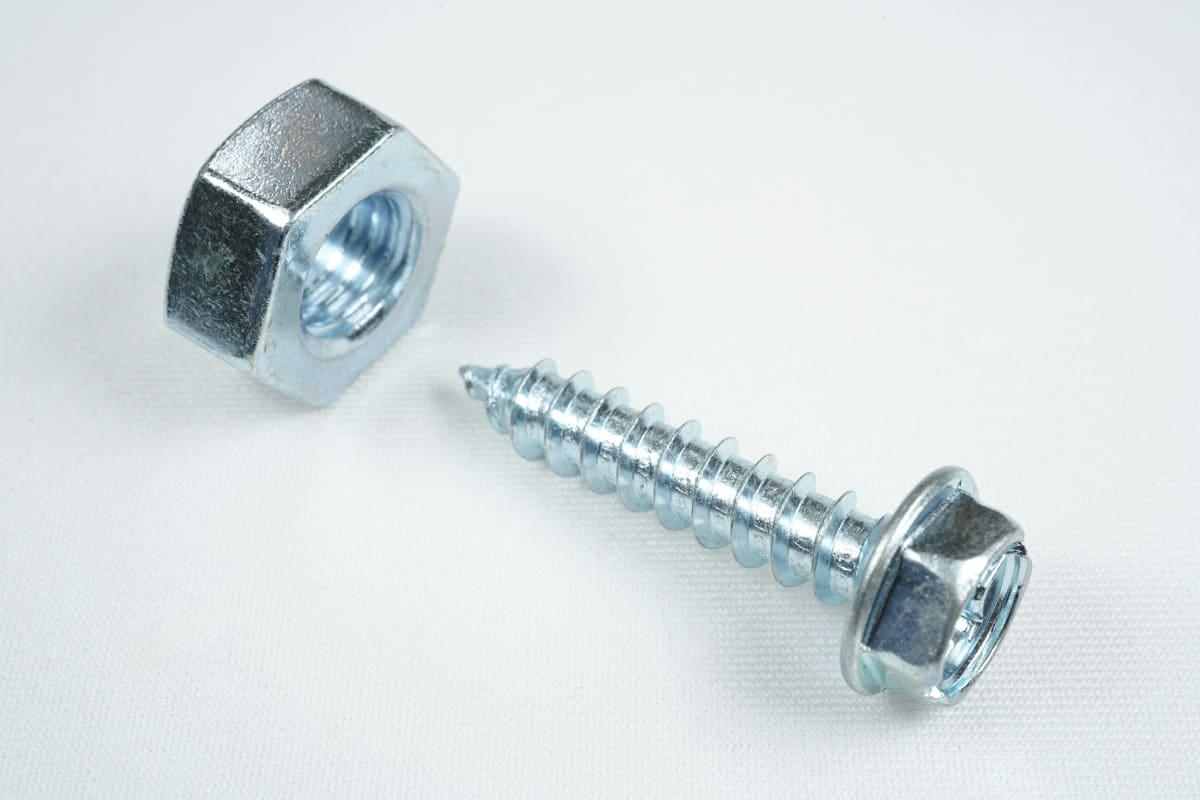
For most work, grab the hex head. It sits on top of the piece, drives with a socket, and is built to resist spinouts and snapped heads; the newer version has ribs under the washer head. Use it on brackets, electrical boxes, conduit straps and wood blocking. The flat head comes in Phillips or Star drive and countersinks flush, so use it on thresholds, door bucks and the furring strips that go up on a concrete basement wall before the drywall, where a flush head keeps the sheet flat. Montana footings go 36 to 48 inches down to get below frost, so basements are standard here, and finishing one starts with furring Tapconned to the foundation wall. The two are measured differently. A hex head’s length runs from under the head, because the head stays outside the piece. A flat head’s length is overall.
3/16 or 1/4, and how long
The 3/16 is the light-duty screw for furring, boxes, straps and thresholds. When the piece carries weight, like shelf standards or a workbench ledger on a basement wall, step up to the 1/4. Every Tapcon wants at least 1 inch in the masonry and no more than 1-3/4 inches, so the length is the thickness of what you’re fastening plus 1 to 1-3/4 inches. Going deeper doesn’t help: extra depth adds friction while the screw taps its threads, and past a point it twists off before it seats. Pick the shortest screw that gets a full inch into the concrete through your piece.
Tapcon’s own chart does the math:
| Screw length | Thickness of the piece | Bit length |
|---|---|---|
| 1-1/4” | Up to 1/4” | 3-1/2” |
| 1-3/4” | Up to 3/4” | 3-1/2” |
| 2-1/4” | 1/2” to 1-1/4” | 4-1/2” |
| 2-3/4” | 1” to 1-3/4” | 4-1/2” |
| 3-1/4” to 3-3/4” | 2” to 2-3/4” | 5-1/2” |
| 4” | 2-1/4” to 3” | 5-1/2” |
A 1x3 furring strip is 3/4 inch thick and takes a 1-3/4 inch screw; a 2x4 laid flat is 1-1/2 inches and takes a 2-3/4.
How to install Tapcon screws
Hold the piece in place and drill through it into the masonry with a hammer drill and the Tapcon carbide bit for that screw: 5/32 inch for a 3/16 screw, 3/16 inch for a 1/4. Tapcon makes its bits to tighter tolerances than standard bits, and the bit is smaller than the screw on purpose, because the difference is the thread the screw cuts. A bit the same size as the screw leaves a hole the screw spins in from the first turn. In soft block, hold the drill steady, because a wobbling bit leaves a hole too big to grip. Drill 1/4 inch deeper than the screw will reach so leftover dust has somewhere to go, then blow the hole out with a bulb or compressed air. A screw that bottoms out on dust can over-torque and snap. Drive it with a nut driver (1/4-inch hex for the 3/16 screw, 5/16-inch for the 1/4) or a Phillips bit, and stop as soon as the head is seated, because one more squeeze strips the threads the screw just cut.
Genuine Tapcon or any blue concrete screw
A genuine Tapcon comes with paper a lookalike blue screw doesn’t. Every head is stamped BX or TAPCON with a letter that codes its length, so on inspected work the inspector can identify the screw and its length after it’s driven. The stamp ties the screw to Tapcon’s ICC-ES evaluation reports, ESR-2202 for concrete and ESR-1671 for masonry, and the anchors are made in the U.S.A. under a quality-control program with ICC-ES inspections. The box carries the ITW name and the report number. Plenty of concrete screws get called Tapcons at the counter; the stamp is how you know you have one.
Blue, white or silver
Blue Climaseal is the standard coating, a water-based polymer cured at high temperature for corrosion resistance. Ultrashield is silver, usually applied in several coats and also cured with heat. White Ultrashield blends into light masonry and white trim, so use it where the heads will show. Black Climaseal and Silver Climaseal are also made.
Block, spacing and where Tapcons belong
In block, drive the screw into the face shell and keep it at least 4 inches from the edge of the block. A screw in a mortar joint holds only as well as the mortar around it, so aim for the block. Space 3/16 screws at least 1-1/2 inches apart and 1/4 screws at least 2 inches.
Tapcon’s code listings are written for dry, interior work, and the masonry report leaves contact with preservative-treated or fire-retardant-treated wood outside its scope, so a treated sill plate is not what the listing covers. What it does cover is the work inside the foundation: furring and blocking on a basement wall, electrical boxes, conduit straps, shelf standards, a workbench ledger, brackets on a garage wall. For that work a genuine Tapcon is the anchor to buy: one hole, one screw, no shield to set, a stamped head the inspector can read, and it backs out when the job changes.
Specs
| Spec | Genuine Tapcon |
|---|---|
| Material | Carbon steel, supplementary heat treatment |
| Thread | Alternating high-low |
| Diameters | 3/16” and 1/4” |
| Head styles | Hex washer head (with or without underhead ribs), Phillips or Star flat head |
| Drill bit | 5/32” for 3/16”; 3/16” for 1/4” |
| Embedment | 1” minimum, 1-3/4” maximum |
| Hole depth | 1/4” deeper than embedment |
| Driver | 1/4” hex or #2 Phillips for 3/16”; 5/16” hex or #3 Phillips for 1/4” |
| Minimum spacing | 1-1/2” (3/16”), 2” (1/4”) |
| Coatings | Blue, Black and Silver Climaseal; Ultrashield; White Ultrashield |
| Listed use | Dry, interior |
| Made in | U.S.A. |
| Concrete report | ICC-ES ESR-2202: static and wind loads, tension and shear, uncracked normal-weight and lightweight concrete |
| Masonry report | ICC-ES ESR-1671 |
Frequently Asked Questions
What are Tapcon screws, and how are they different from an expansion anchor?
They’re heat-treated carbon steel screws that cut their own threads into concrete, block or brick. The grip comes from those threads in the base material, not from a sleeve pushing outward, so they don’t wedge against brittle block or old brick the way an expansion anchor can near an edge. They also back out with the drill in reverse, which makes them a good pick for anything you may want to move later.
What size drill bit do Tapcon screws use?
A 5/32-inch bit for the 3/16 screw and a 3/16-inch bit for the 1/4. Use the Tapcon carbide bit, which is made to tighter tolerances than a standard masonry bit, and drill 1/4 inch deeper than the screw goes in.
How deep does a Tapcon need to go into concrete?
At least 1 inch and no more than 1-3/4 inches. Add that to the thickness of the piece you’re fastening to get the screw length.
Can Tapcons go into poured concrete as well as block?
Yes, and poured concrete has the broader listing: Tapcon’s concrete report covers wind loads along with static loads, while the block listing leaves wind out. The concrete has to be uncracked, so check the slab or wall and drill away from any cracks you can see.
What are the ribs under a hex head Tapcon for?
Tapcon added underhead ribs to help more installs go right the first time. As the head comes down, the ribs bite into the wood or metal you’re fastening, so the head stops hard when it seats. Pick the ribbed hex head for wood blocking and ledgers.
What do you do when a Tapcon spins in the hole?
Back it out. A screw that spins has stripped the threads it cut, and it won’t tighten however long you drive it. Either move over and drill a fresh hole, or redrill the same hole with the 3/16-inch bit and step up to a 1/4-inch screw.
Ready to Get Started?
Our building materials specialists can help you find the right Tapcon products for your project.