

A Swanson Speed Square is the aluminum triangle framers, carpenters and serious DIYers hook on a board edge to mark square and 45° lines, guide a circular saw and lay out rafters. One die-cast piece does the work of a try square, miter square, saw guide, line scriber and protractor, and every mark is cast into the metal.
Swanson Tool Company is based in Frankfort, Illinois, and has made tools in the USA since 1925, the year Chicago carpenter Albert J. Swanson invented the Speed Square. The Allemand family owns the company today. Every Speed Square is still CNC machined, packaged and shipped in Frankfort.
Marking and saw guiding with the 7-inch Speed Square
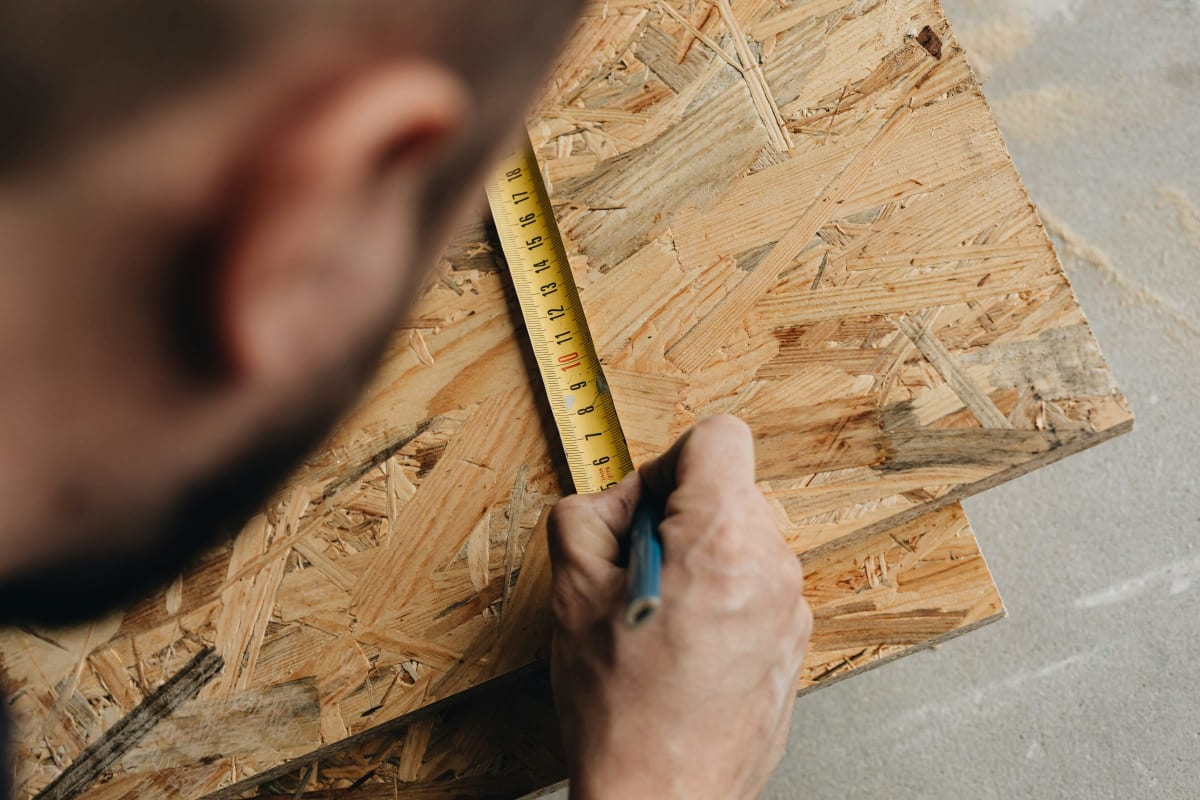
Hook the 7/8-inch heel over the board edge and pull it tight. Pencil down the blade for a square line, or down the long diagonal edge for a 45°. To guide a circular saw, hook the heel on the edge nearest you, clamp it down hard with your off hand, and run the saw shoe along the blade from start to finish. The most common mistake is a heel riding loose: the saw pushes the square, the square pivots, and the cut walks off the line. For a rip line, set the pencil in the scribe bar notch at your width and slide the heel down the board.
The markings are deep black on a matte finish, made to stay readable in direct sunlight. The tag-carded version comes with plain markings. Buy the carded version, which adds the Blue Book of Rafter Lengths and a Speed Clip.
Rafters with the One-Number Method and the Diamond
The 7-inch square carries degree, common rafter and hip/valley scales, and Swanson’s One-Number Method runs every rafter off them. The 3½-inch Diamond cutout along the centerline marks the seat cut on common, hip and valley rafters in one motion. The Blue Book covers rafter tables, roof pitches and stair geometry, and the same reference is indexed, searchable and free on every device. Read the pitch number off the plan once and use it for every rafter on the job. Set the pivot point on the rafter’s top edge, rotate the square until that number on the common scale lines up with the same edge, and draw the plumb line down the ruled edge. Hips and valleys take the same pitch number on the hip/valley scale.
Drops off the scaffold
A square that goes off the scaffold all day raises two worries: the marks wearing off and the corner going out. Every graduation, rafter number and degree mark on a Speed Square is cast into the aluminum itself, so the marks are part of the casting. The body is a heavy-gauge die-cast aluminum alloy, and each corner is CNC machined to 45° and 90°. A hard landing on concrete can still dent an edge, and a dent on the heel throws a line. After a bad fall, hold the heel on a straight factory edge, draw a line along the blade, flip the square and draw again from the same point; when the two lines sit on top of each other, the corner is still 90°.
The Big 12 and its Layout Bar
The Big 12 Speed Square stretches the original design to a 12-inch body with 70% more reach, for framing big lumber, stair stringers and full-sheet layouts. It adds an inch ruler in 1/8-inch marks, and its scribe bar along the long edge is milled in 1/8-inch increments for rafter and stringer scribing.
The Layout Bar bolts to the underside with two wing nuts, and two adjustable stop pegs lock to your rise and run. Once it’s set, the Big 12 works as a repeatable jig: step it down a stringer or across deck framing and every mark comes out the same. The bar also carries layout past the 12-inch reach for long stringers and full sheets, marks parallel lines without a chalk box, and measures the offset on an out-of-square corner, which is how a countertop gets scribed to a crooked wall. At 1.05 lb it’s a ground tool and too big for a pouch, so wear the 7-inch and keep the Big 12 at the sawhorses. Before cutting a stringer, snug both wing nuts and check the last step against the first, because a peg that creeps a sixteenth adds up over a full flight.
The rest of the Swanson line
Swanson also makes the 7-inch Speed Square Pro, the 8-inch Speedlite Level Square for checking level off the square, a lighter 8-inch plastic rafter square, a carpenter pencil for marking and a magnetic post level for plumbing posts. Further out in the catalog are a black anodized 16 x 24 rafter square, with white graduations that stay readable in sun and common rafter, brace, essex and octagon tables on the blade, and Savage, Swanson’s pro-tier line of levels, a 9-inch try square and a 9-inch T-bevel. Swanson-branded tools, the Big 12 included, are covered for 1 year against defects in material and workmanship. For long coverage on a level, pick Savage: its levels are guaranteed to hold their stated accuracy for life, and a bent or twisted Savage level loses that guarantee.

Speed Square specs
| Spec | 7-inch Speed Square | Big 12 Speed Square |
|---|---|---|
| Model | S0101 | S0107 |
| Size | 7 in. | 12 in. |
| Weight | 0.68 lb | 1.05 lb |
| Carded package includes | Blue Book, Speed Clip | Layout Bar, Blue Book |
Frequently Asked Questions
How do you use a Swanson Speed Square to mark an angle other than 45°?
The degree scale turns the square into a protractor for any angle cut. Hold the pivot point against the board edge, swing the square until the degree you need lines up with that same edge, and draw your line down the ruled side. Put a small X on the waste side before you cut so the saw kerf comes out of the scrap and not out of your piece.
What is the Swanson rafter square?
It’s Swanson’s 16 x 24 inch aluminum framing square, anodized black and sized for stud, rafter and stair layout. The blade has 1/8, 1/10, 1/12, 1/16 and 1/100 graduations impressed into the metal, and the 1/100 scale is the one to use when a calculator gives you a decimal you need to turn into a mark. The aluminum body stands up to nicks and scratches, so it’s a good pick for layouts longer than a triangle square can reach.
Where are Swanson tools made?
Swanson has made tools in the USA since 1925 and has used the same factory the whole time, turning out thousands of Speed Squares a day. The tools are built from heavy-gauge aluminum alloy, hardened stainless steel and brass hardware, so the parts that take jobsite wear aren’t cheap steel that rusts out.
Ready to Get Started?
Our tool specialists can help you find the right Swanson products for your project.