
Schulte ventilated wire shelving is the white wire shelf in closets, pantries and laundry rooms across the country, and the shelf and every part that holds it up are still made. A new closet goes up with shelving built on thick, powder-coated wire and patented Tri-Loc anchors, and an old Schulte closet with one sagging shelf gets fixed with matching brackets and braces instead of torn out.
Schulte started in 1919, when George Schulte and his brother began making solid brass faucets and plumbing fixtures in a garage in Norwood, Ohio, as The Schulte Brass Company. It launched its ventilated shelving line in 1976, built its wire around an epoxy powder coating, and changed its corporate name to Organized Living on January 1, 2013. The company is headquartered in Cincinnati, makes its storage products in the USA, and does nothing but storage and organization.
The shelf
The Schulte shelf is 16 inches deep and comes in 12-foot lengths, cut down to fit the wall with bolt cutters. End caps cover the cut wire ends so they don’t snag clothes or hands, and joiner clips tie two sections together when one piece won’t span the wall. The wire is the thickest gauge in the business under an epoxy powder coat, and the fixed ventilated shelf is rated to carry up to 75 pounds per linear foot, which is a shelf of canned goods or a row of winter boots without a sag. Because it’s open, air moves through it, dust falls through instead of piling up, and light from the closet fixture reaches the bottom shelf.
That open wire is the reason to use it in a Montana mudroom or entry closet. From the first snow in October until the last slush in April, wet coats, gloves and pac boots come in every evening, and on a wire shelf they drip through and dry by morning instead of sitting in a puddle on a solid board. Give the boots the bottom shelf and the wet gloves the one above it, and the drips land on the floor mat, not on the coats.
What holds it up
A wire shelf is only as strong as the hardware under it, and Schulte makes every piece of it.
The side wall bracket supports the front of the shelf where it meets a side wall, with a double anchor to carry a heavy load, and it comes with Tri-Loc anchors. Support braces run from the front edge of the shelf down to the back wall and carry the weight the back clips can’t. They come sized to the shelf depth: the 20-inch brace reaches the front wire of the 16-inch shelf, and the 12-inch brace is for a shallower 12-inch linen or pantry shelf. The more weight a shelf will hold, the more braces it wants under it, and a shelf that carries the winter coats wants one on every stud it can reach. Versa-Clips attach the back of the shelf to the wall and double as a hold-down clip. A corner bracket handles the spot where two runs meet in a corner.
For the hanging side of the closet, the 40-inch horizontal hanging rail is the wall-mounted track that Organized Living’s freedomRail uprights hang from, so a rod-and-shelf run can be moved up or down later without new holes, and the chrome rod clip holds the clothes rod on that system and adjusts without tools.
Tri-Loc II anchors are what make all of it hold in drywall. They’re Schulte’s patented anchoring system for side wall brackets and support braces, sold in bags of ten, each with its own screw and anchor, so there’s always a matching anchor on hand for a new bracket or a fresh hole.
Fixing an old Schulte closet
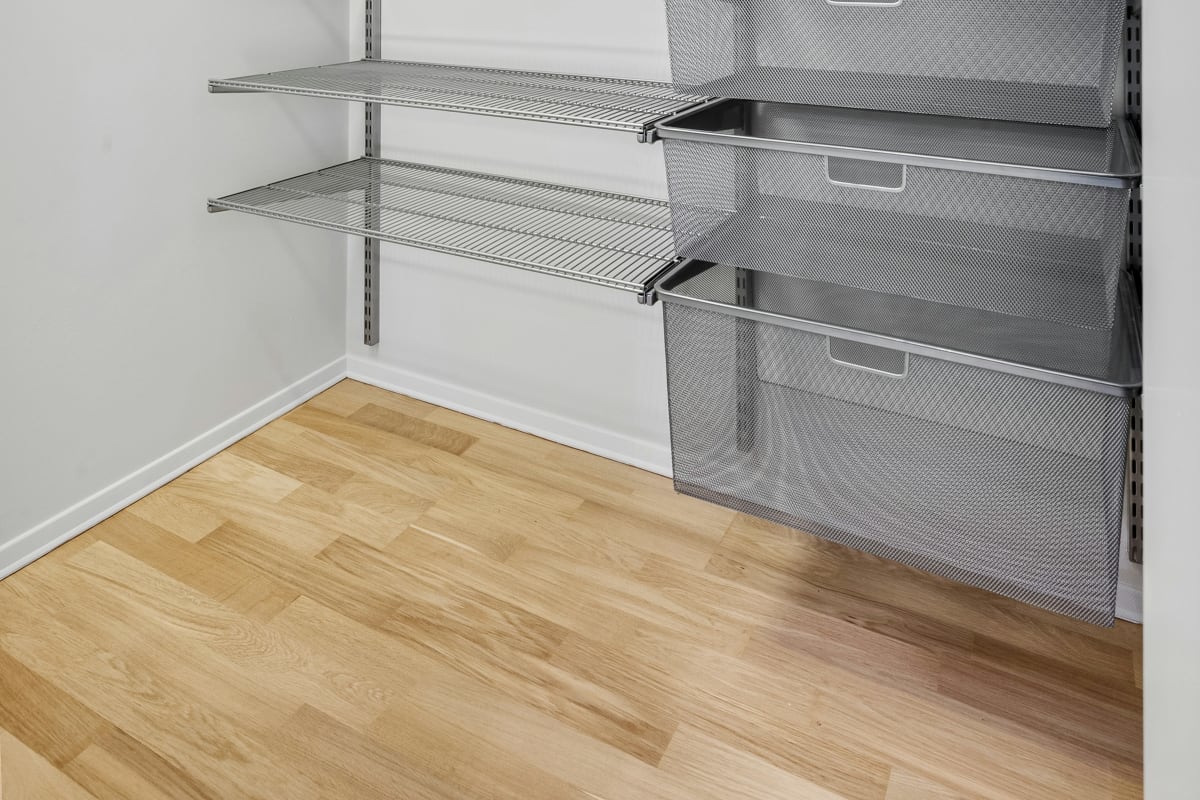
A sagging or pulled-out Schulte shelf almost never needs a new closet. In the older houses around the Flathead and the Bitterroot the wall behind it is often plaster over lath, or drywall that has had forty years of coats hung on it, and what fails is the anchor, not the wire. The fix is a support brace under the front edge where the weight sits, fresh Tri-Loc anchors in new holes beside the old ones, and a side wall bracket at any end that was left hanging on the back clips alone. Because the line is still made to the same design, the new parts fit the wire that’s already on the wall.
Schulte parts at a glance
| Part | Size or pack | What it does |
|---|---|---|
| Ventilated storage shelf | 16 in deep, 12 ft long, white | The shelf; rated up to 75 lb per linear foot, cut to length with bolt cutters |
| Side wall bracket with Tri-Loc | One per shelf end at a side wall | Carries the front of the shelf; double anchor for heavy loads |
| Support brace | 12 in or 20 in | Runs from the front wire to the back wall; 20 in for the 16 in shelf |
| Versa-Clip with Tri-Loc | Spaced along the back wire | Holds the back wire to the wall and holds the shelf down |
| Tri-Loc II anchor | Bag of ten, each with a screw | The patented drywall anchor for brackets and braces |
| Metal corner bracket | One per inside corner | Ties two shelf runs together at the corner |
| End caps | Double, large (50 per package), or kit | Cover cut wire ends |
| Joiner clip | One per splice | Ties two shelf sections end to end |
| Horizontal hanging rail | 40 in | Wall track for the freedomRail adjustable system |
| Rod clip | Chrome | Holds the clothes rod on freedomRail, adjusts without tools |
Past ventilated wire, Organized Living also makes wood and built-in closet lines, which go up with the same anchors.
Why Schulte
Schulte shelving goes up in an afternoon and carries a real load on thick, powder-coated wire held to the wall by patented anchors. The bigger reason is that the parts are still made: brackets, braces, clips, end caps and anchors that fit the shelves already in the closet, so a Schulte closet can be fixed, extended or rebuilt one part at a time.
Frequently Asked Questions
Is Schulte shelving still made?
Yes. Schulte Corp. changed its name to Organized Living in 2013, and it still makes the ventilated wire shelving along with the side wall brackets, support braces, clips, end caps and Tri-Loc anchors that fit it, including on older Schulte closets.
Is the Schulte side wall bracket the same as an end bracket?
Yes. When people ask for an end bracket for Schulte wire shelving, the side wall bracket is the part they mean. It holds the front of the shelf where it meets a side wall, and it comes with Tri-Loc anchors.
What is a Tri-Loc anchor?
Tri-Loc II is Schulte’s patented wall anchor for mounting side wall brackets and support braces in drywall. Each one comes with its own screw, and they’re sold in bags of ten.
Can you cut Schulte wire shelving?
Yes. Cut it to length with bolt cutters, cover the cut ends with end caps, and use joiner clips to tie two sections together on a longer wall.
Ready to Get Started?
Our building materials specialists can help you find the right Schulte products for your project.