

Reflectix insulation rolls are for homeowners and contractors insulating walls, floors, crawl spaces and ductwork. Double Reflective insulation reflects 96% of radiant heat. Its installation requires an air space facing at least one reflective side.
Reflectix, Inc. is a reflective-insulation manufacturer based in Markleville, Indiana. It began as an energy-management company in the early 1980s and began manufacturing Reflectix insulation in 1985. Balcan Innovations acquired the company in 2021. Its flagship product is Double Reflective Insulation.
Double Reflective insulation needs room to work
The reflective faces do a specific job: they reflect radiant heat. Two layers of heavy-gauge polyethylene bubbles sit between those faces. The useful question on your job is how the roll fits into the finished assembly.
The system R-value describes the complete assembly, including the insulation and other building materials. Air-space size and heat-flow direction change the thermal performance. Build the matching assembly. The installation details on the reverse of the label give the air-space requirements for each application.
Fit the roll to the framing
Double Reflective insulation comes with standard edges or staple-tab edges. The staple-tab version gives you a tab for fastening in a cavity and is recommended for 16- or 24-inch cavities.
Choose the width around the framing and the cuts, because every extra piece gives you another seam to finish. Measure the space, mark your cuts and use scissors or a utility knife against a straightedge. Keep the required air space in your layout as you fasten it. When using a staple gun, wear eye protection and locate wiring before driving staples.
Reflectix Foil Tape is intended for seams on the reflective faces of its insulation. Lay out the pieces so the edges meet cleanly, then finish the seams according to the application instructions.
Duct insulation and radiant barrier
Reflectix Indoor Duct Insulation is a fiber-free wrap for round or rectangular HVAC ducts, with R-4.2, R-5.6 and R-6.0 options that depend on the installation technique.
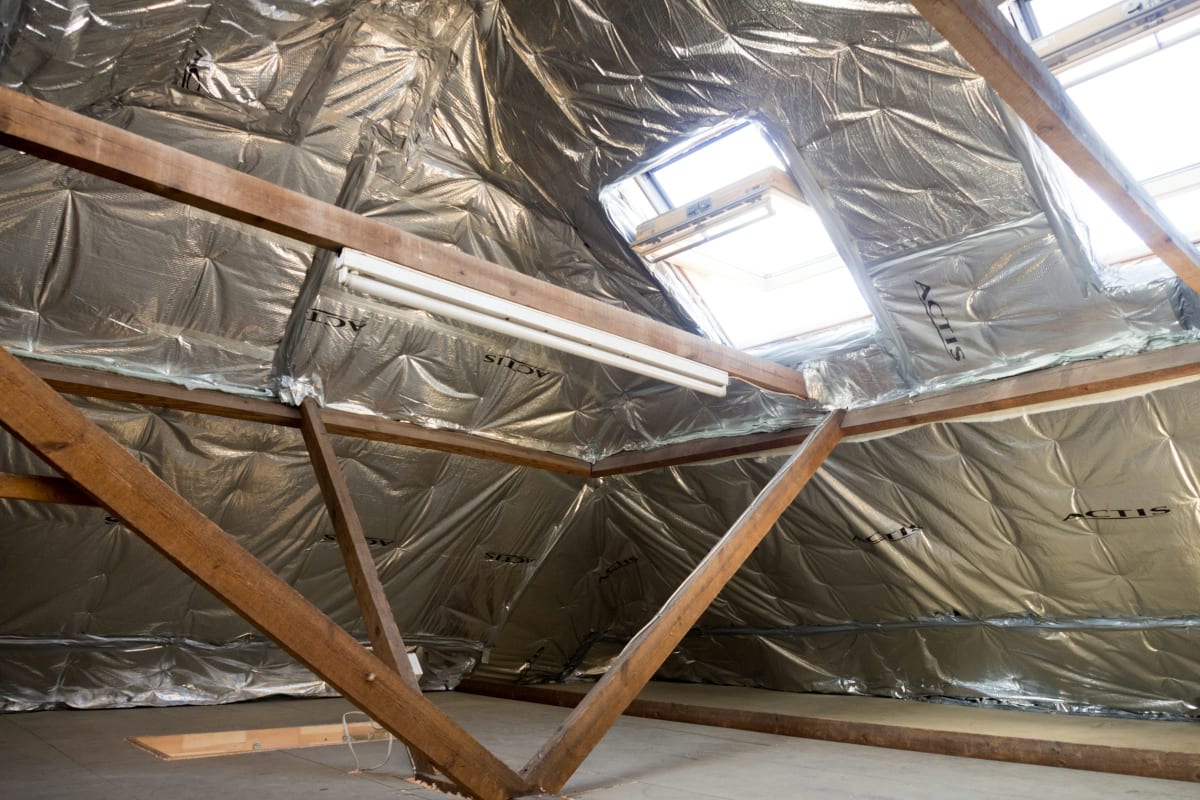
Reflectix Radiant Barrier uses woven polyethylene between reflective film layers for radiant-heat control, with the described attic installation restricted to the southern USA.
Seal the foundation-to-sill joint
Reflectix Sill Sealer uses ribbed polyethylene foam to reduce air leakage between the foundation wall and sill plate. That joint deserves attention while it’s accessible. Install a continuous course between the foundation wall or footing and the sill plate.
Foam expansion joint for concrete work
Reflectix Expansion Joint is closed-cell foam that follows contours, which helps when you’re fitting a concrete joint along an irregular edge. The 4-inch-wide version is 0.5 inch thick and comes in a 50-foot roll.
Product specifications
| Product | Family or ordering code | Specifications |
|---|---|---|
| Double Reflective Insulation | BP | Reflective/bubble/bubble/reflective construction; nominal thickness of 5/16 inch; manufactured widths from 16 inches to 10 feet and lengths from 50 to 125 feet |
| Double Reflective Staple Tab Insulation | ST | Reflective/bubble/bubble/reflective construction with staple-tab edges; recommended for 16- or 24-inch cavities |
| Foil Tape | FT | Widths of 2 and 3 inches; lengths of 30 and 150 feet |
| Sill Sealer | CF | Ribbed polyethylene foam; nominal thickness of 3/16 inch; widths of 3.5, 5.5, 7.5 and 9.5 inches; 50-foot rolls |
| Expansion Joint | EXP04050 | Closed-cell foam; 0.5 inch thick by 4 inches wide by 50 feet long |
Frequently Asked Questions
Does Reflectix insulation actually work?
Yes, Reflectix insulation works when you give the reflective face the air space the installation requires. Its 96% radiant-heat reflectivity isn’t an R-value or a promise to cut total heat loss by 96%. For your job, judge performance by the complete assembly’s R-value, which depends on air-space size and heat-flow direction.
How do you install Reflectix insulation?
You install Reflectix insulation with an air space facing at least one reflective side. Where the assembly requires an enclosed air space, keep that cavity closed off from free airflow. Staple-tab edges suit 16- or 24-inch cavities, but you still need to preserve the required air space when fastening. Replace worn wiring before starting, and keep staples clear of wires.
Is Reflectix radiant barrier the same as the double bubble insulation?
No. Reflectix radiant barrier has woven polyethylene between its reflective films, while the double bubble insulation has two layers of polyethylene bubbles. The described radiant-barrier attic installation is restricted to the southern USA and calls for 2-inch seam overlaps with no tape. Keep those installation details separate from a bubble-insulation assembly.
What tape do you use with Reflectix insulation?
Use Reflectix Foil Tape for seams on reflective insulation faces and White Poly Tape for seams on white-poly insulation. Match the tape to the face you’re joining. The radiant-barrier installation calls for untaped overlaps, so taping every seam isn’t a rule that carries across the whole product line.
Ready to Get Started?
Our building materials specialists can help you find the right Reflectix products for your project.