

Crescent makes the adjustable wrench that everybody else’s adjustable wrench gets named after, and it has been making it since 1907. Around that wrench sits a full hand-tool family: pry bars and nail pullers for tear-out, Wiss snips for sheet metal, Nicholson files for sharpening and fitting, and Lufkin tapes for layout. In Montana that covers the year pretty well, from frozen-pipe repairs in January to deck boards in May and firewood in September.
The Crescent Tool Company was founded in Jamestown, New York, in 1907 by Karl Peterson and Edward J. Worcester, and the adjustable wrench came out that same year. A Crescent wrench and a pair of slip-joint pliers rode along in the tool kit of the Ford Model T, and Charles Lindbergh said he carried a Crescent wrench and pliers on his 1927 flight across the Atlantic. Today Crescent is part of Apex Tool Group, and since 2017 the Wiss, Lufkin, Nicholson and H.K. Porter names have all been part of the Crescent family.
Crescent Adjustable Wrenches
A Crescent wrench is an open-end wrench with one fixed jaw and one jaw that moves when you turn the knurl, so a single tool fits a whole run of nut and bolt sizes. The chrome AC series comes in 6-inch (AC26VS), 8-inch (AC28VS) and 12-inch (AC212VS) lengths. The 12-inch opens to 1-1/2 inches and weighs 1.81 pounds, which is enough wrench for water heater unions and hitch hardware without carrying a pipe wrench for everything.
The details are what keep these in the truck. The scale laser-etched on the jaw reads in both SAE and metric, so you can size a fastener before you crawl under the sink. The larger knurl holds its setting, and that matters more than anything else on an adjustable, because a jaw that creeps open is how corners get rounded. The body is heat-treated forged alloy steel with a chrome finish that wipes clean.
The black wide-jaw wrenches are the ones to look at when space is tight. The 10-inch wide-jaw opens to 1-1/2 inches, the same capacity as the 12-inch chrome wrench, and the 8-inch opens to 1-1/8 inches. Each one is built to meet the strength requirement for the next size up, and the jaws have fine serrations that bite the fastener. A shorter handle with a bigger mouth is exactly what you want behind a toilet or inside a vanity. The 6-inch and 10-inch also come as a two-piece set, and the chrome wrenches come as a 6, 8 and 10-inch kit.
For round pipe, the 12-inch self-adjusting pipe wrench grips and releases with one hand and ratchets without being reset. It handles pipe and fittings up to 1-1/2 inches across black iron, galvanized, copper and PVC, and it weighs 1.29 pounds. When a line freezes and splits in a crawlspace in January, one-handed is the only way you’re going to work.
Crescent Pry Bars
“Crescent bar” is what a lot of people call a flat pry bar, and Crescent makes a bar for each kind of tear-out. The 8-inch and 10-inch molding bars have a thin, flat edge that slides behind trim and baseboard and a rocker head for leverage on nails. The 8-inch weighs half a pound. Use these when the trim is going back on, which is the usual plan on a winter flooring job.
The 15-inch flat bar is the general-purpose bar for siding, sheathing and stuck boards. The 18-inch indexing bar is the one worth stepping up to: its head swings through more than 180 degrees and locks in 15 positions, so you set the angle to the work instead of fighting a joist or a wall for room to swing. It has a raised striking surface for driving the claw under a board and weighs 2.9 pounds. The 30-inch bar is there for leverage when the material is heavy.
Montana decks live 10 to 25 years, and freeze-thaw is what cracks and warps the boards. Spring deck repair means pulling bad boards from between good ones, and an indexing head lets you lift straight up from the joist without chewing the neighbor board.
Nail Pullers
The 11-inch nail-pulling pliers are the tool that makes trim salvage work. The jaws grip finish nails, brads, staples and damaged or headless fasteners, and a roll bar on the head gives you leverage as you roll the tool over. Pull a finish nail through the back of a baseboard and the face never splinters. They’re forged chrome-vanadium steel and weigh 1.5 pounds.
The 19-inch Crescent 56 is the opposite kind of tool. It is a sliding nail puller: you hammer the jaws down around a buried nail with the sliding handle, then lever the nail out. It weighs just over 6 pounds and it will pull fasteners nothing else can reach, which is what you need when you are salvaging barn wood or old fir. The 24-inch adjustable bar has a jaw that slides and clamps onto a board or a nail, plus two striking surfaces.
Wiss Snips and Scissors
Wiss is the sheet-metal side of the family. The offset aviation snips come in two hands: the M6R cuts straight and left, the M7R cuts straight and right. Both are 9-1/4 inches long, cut up to 18-gauge low-carbon steel, and are made in the USA. The blades sit at a 30-degree offset so your hand rides above the metal instead of getting cut by it, and the serrated edges hold the sheet while you cut. Buy the pair. Metal roofing, flashing and the steel siding on pole barns all need cuts in both directions.
The tinner snips are for long straight cuts and gentle curves in lighter sheet: a 7-inch straight snip, 10-inch regular and combination patterns, and a 13-inch combination pattern for more reach per stroke. The family also includes a compound-action snip, a 7-inch titanium-coated utility scissor with stainless blades and a locking latch, and a two-pack of lightweight scissors.
Nicholson Files
Nicholson files are single-purpose tools, so choose by shape. The round bastard files in 6, 8 and 10-inch lengths open up holes and work inside curves. The 10-inch half-round has one flat face and one rounded face and cuts iron, mild steel, plastic and wood. The mill bastard files, an 8-inch and a 6-inch with a handle, are the ones for sharpening: mower blades, shovels, hoes and saws, and for draw-filing a clean edge on steel. The 8-inch 4-in-hand puts two rasps and two files on one tool, flat on one side and half-round on the other, and it is the one to keep in a kitchen drawer or a fencing bucket.
The chainsaw files are round files in 1/8 inch by 6 inches and 7/32 inch by 8 inches. The diameter has to match the chain: 7/32 inch is the size for standard 3/8-inch pitch chain, the chain on most firewood saws, and the 1/8-inch is for the smallest chains. The right size is printed in the saw’s manual and on the chain box. A lot of Montana homes heat with wood, and a few strokes per tooth at every fill-up beats forcing a dull chain through a cord of larch.

Lufkin Tapes, the Rafter Square and Nail Slicer Blades
The Lufkin Nite Eye tapes have a 1-3/16-inch blade: a 25-foot power tape and the 35-foot Shockforce. The Nite Eye blade is a high-contrast blade that stays readable in low light. Winter daylight is short here, and the inside of a post-frame shop or a crawlspace is never bright. The 35-foot is the right length for laying out a pole barn bay without moving the hook. A 25-foot Command Control tape with a black blade rounds out the choices, and the Crescent EX6 aluminum rafter square handles layout for roof cuts and stair stringers.
The Nail Slicer circular saw blades are carbide-tipped, 24-tooth framing blades with a 5/8-inch arbor, in 6-1/2-inch and 7-1/4-inch diameters. They are built to cut nail-embedded wood, so they are the blades for demolition, remodels and reclaimed lumber, where an ordinary blade loses its teeth to the first hidden nail.
Crescent Sizes at a Glance
| Tool | Size | What to know |
|---|---|---|
| AC212VS adjustable wrench | 12 in. | Opens to 1-1/2 in.; 1.81 lb; SAE and metric jaw scale |
| Wide-jaw adjustable wrench | 10 in. | Opens to 1-1/2 in., the capacity of a 12 in. wrench |
| Wide-jaw adjustable wrench | 8 in. | Opens to 1-1/8 in. |
| Self-adjusting pipe wrench | 12 in. | Up to 1-1/2 in.; one-hand ratcheting; 1.29 lb |
| Molding bar | 8 in. and 10 in. | Thin flat edge for trim you plan to reuse |
| Indexing flat pry bar | 18 in. | Head locks in 15 positions over 180 degrees; 2.9 lb |
| Nail-pulling pliers | 11 in. | Pulls finish nails from the front or the back; 1.5 lb |
| Crescent 56 nail puller | 19 in. | Sliding handle drives the jaws around buried nails; about 6 lb |
| Wiss offset aviation snips | 9-1/4 in. | 18-gauge steel; left and right cut; made in the USA |
| Nicholson chainsaw files | 1/8 x 6 in. and 7/32 x 8 in. | Match the diameter to the chain pitch |
| Lufkin Nite Eye tapes | 25 ft and 35 ft | 1-3/16 in. high-contrast blade |
| Nail Slicer saw blade | 6-1/2 in. and 7-1/4 in. | 24 carbide teeth; cuts nail-embedded wood |
Why Crescent
Crescent has made the adjustable wrench since 1907, and the current ones show it: more jaw opening for the length, a knurl that holds, and a scale you can read. The rest of the family earns its place the same way, with a pry bar head that locks in 15 positions, pliers that pull a finish nail without marking the face, and snips that cut 18-gauge steel. Crescent backs its wrenches, pry bars, nail pullers and snips with a full lifetime warranty. For a Montana toolbox that has to cover plumbing in winter, decks in spring and firewood in fall, this is one brand that covers all of it.
Frequently Asked Questions
What is a Crescent wrench?
A Crescent wrench is an adjustable wrench: an open-end wrench with one fixed jaw and one movable jaw that you set with a knurled wheel. The Crescent Tool Company introduced it in 1907, and the name stuck to the whole type of tool. One 12-inch Crescent wrench opens to 1-1/2 inches and replaces a drawer of fixed wrenches for most repair work.
What does a Crescent wrench look like?
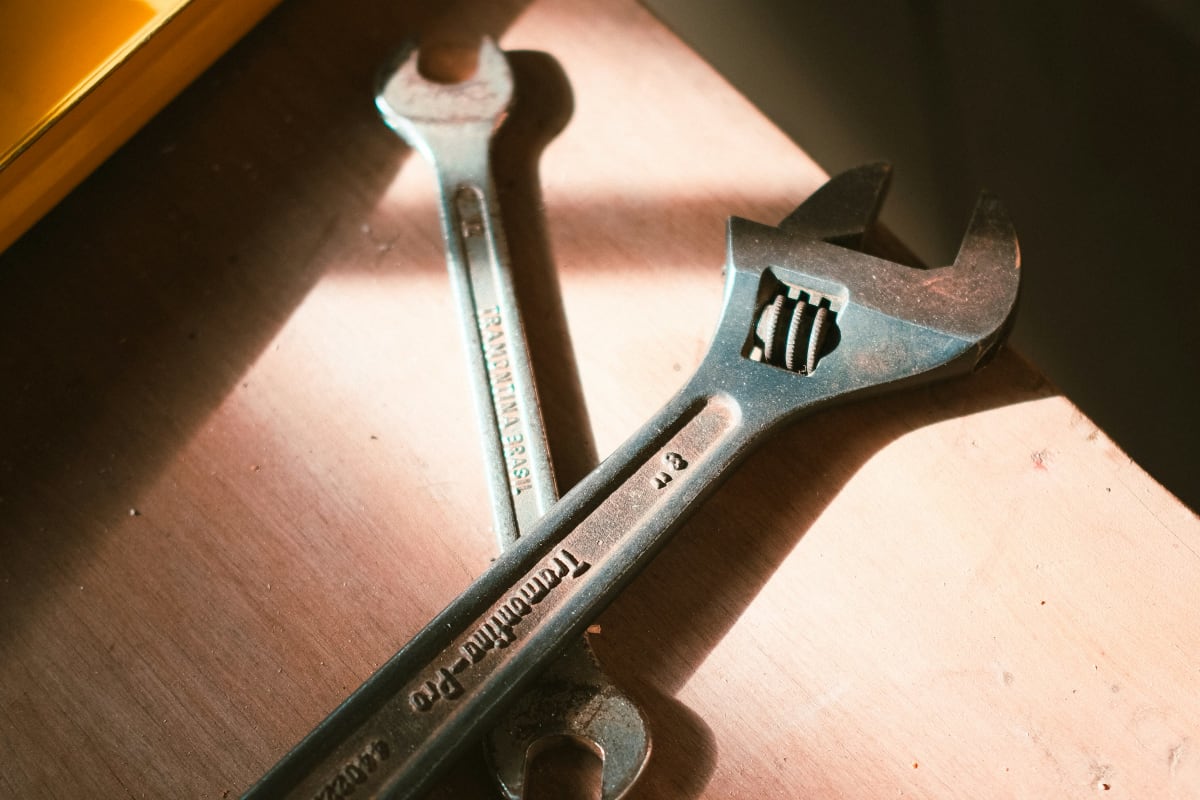
A Crescent wrench has a flat handle and an open head set at a slight angle, with one jaw fixed to the body and one jaw that slides. A knurled wheel just below the head moves the sliding jaw. Current Crescent wrenches also have a size scale laser-etched on the jaw in SAE and metric.
What tools does the Crescent brand make?
Crescent makes adjustable wrenches, pipe wrenches, pliers, pry bars and nail pullers under its own name. Wiss snips and scissors, Nicholson files, Lufkin tape measures and H.K. Porter cutters are all part of the Crescent family, which is owned by Apex Tool Group.
What is a Crescent bar used for?
A Crescent bar is a pry bar for prying, lifting and separating material and for pulling nails. The thin molding bars take off trim and baseboard without breaking it, the 15-inch flat bar handles general tear-out, and the 18-inch indexing bar locks its head in 15 positions so you can work in tight spots.
Ready to Get Started?
Our tool specialists can help you find the right Crescent products for your project.