

Chamberlain makes garage door openers built for you to hang yourself, along with the remotes, keypads and myQ phone controls that run them. The reason to buy is that the whole system is matched: every current opener has a DC motor with soft start and stop, the myQ app built in, and safety sensors that won’t let the door close on what’s in its path. The line runs from a 1/2 HP chain drive to a 1-1/4 HP belt drive with battery backup and a camera, plus a wall mount that clears the ceiling entirely.
Chamberlain is the do-it-yourself brand of The Chamberlain Group LLC of Oak Brook, Illinois, which is also the parent company of LiftMaster and myQ. The company has led the garage door opener business for over 40 years and holds over 400 patents worldwide. Every click of a Security+ 2.0 remote sends one of 100 billion unique codes to the opener.
Chamberlain garage door remotes
A Chamberlain garage door remote has to match the opener it talks to, and the opener tells you which one with the color of its LEARN button. On an opener already hanging in your garage, look under the light cover on the same side as the antenna. Yellow, purple, green and orange or red buttons are the earlier generations; the current openers have a white button and work only with Security+ 3.0 accessories. Count the buttons on the remote too, because each one runs one opener, gate operator or myQ light.
The 3-Button Remote CH363 covers the most ground in a Chamberlain garage. It works with the white-button openers and reaches back to yellow, purple and orange or red learn buttons on Chamberlain, LiftMaster and most Craftsman openers made after 1997 with safety sensors. Range is up to 1,300 feet, it runs on one CR2032 coin cell, and it’s rated to operate from -13°F to 185°F. The average winter low in the Flathead Valley is 16°F, so a remote clipped to the visor of a truck parked outside all January is working well inside its rating. The Keychain Remote CH382 gives you the same range and the same cold rating in a two-door size for a key ring.
If the opener isn’t a Chamberlain, LiftMaster or Craftsman, buy a universal. The Universal 2 Button Remote CHU62 fits most brands made after 1993 with safety sensors, including Genie, Linear, Stanley, Wayne-Dalton, Guardian, Sommer and Ryobi, and it covers the white, yellow, purple, orange or red and green Chamberlain buttons as well. The Original Clicker KLIK5U is the long-standing universal: it runs two different brands of opener from one remote, works with over 90% of the openers installed in North America, and has an 800-foot range. The Clicker is made for green, orange or red, purple and yellow learn buttons, so it’s the pick for a mixed pair of older openers, and a white-button opener gets the CHU62. The Universal Mini MC100 does the Clicker’s job from a key ring, at 2.38 inches long with a 1,500-foot range. For an older Chamberlain, LiftMaster or Craftsman opener, the 3-Button Visor Remote 953EV runs three openers at 1,500 feet.
Programming a Chamberlain remote is quick. On the current openers, press and release the LEARN button on the opener; its light glows steady for 30 seconds. Inside that time, press and hold the remote button you want to use, and let go when the opener lights blink or you hear two clicks. You can start from the wall control instead: lift the push bar and press its LEARN button twice. The remote that comes in the box with a new opener is already programmed.
Chamberlain garage door openers: belt drive and chain drive
Choose a Chamberlain garage door opener on two things: the drive and the lifting power. A belt drive moves the trolley with a steel-reinforced rubber belt, and it’s the quiet one, the right choice when a bedroom sits beside or over the garage. A chain drive uses a heavy-duty chain and is the durable, dependable choice for a standard aluminum door on a detached garage or a shop.
Chamberlain’s motors are DC, and it rates them by the AC horsepower they compare to. More lifting power means the motor doesn’t work as hard and typically lasts longer, so when you’re between two sizes, buy up. The 1/2 HP openers suit a sectional aluminum door in daily use. The 3/4 HP and 1 HP openers are built for frequent use, a busy garage with several drivers. The 1-1/4 HP openers are for heavy use, heavier or one-piece doors, and areas with extreme weather, which describes an insulated double door in a Montana winter about as well as anything.
The Chamberlain 1/2 HP garage door opener comes three ways: the C1000 and D1000 chain drives, the C3000 chain drive with battery backup, and the B3000 and B3010 belt drives with battery backup. Step up to 3/4 HP and you get a wide-angle camera in the opener. At the top of the line, the B6850 and B6830 put 2,000 lumens of LED light, a camera with adjustable wide angle and full night vision, and a 10-year warranty on the motor and belt behind a 1-1/4 HP belt drive. Every opener in the table has soft start and stop, myQ built in, and works with HomeLink 4 and up for the buttons in your vehicle.
| Model | Drive | Power | Battery backup | Camera | Motor warranty | Belt or chain warranty |
|---|---|---|---|---|---|---|
| B6850, B6830 | Belt | 1-1/4 HP | Yes | Yes | 10 years | 10 years |
| B6650 | Belt | 1-1/4 HP | Yes | Yes | 10 years | 10 years |
| B6630 | Belt | 1 HP | Yes | Yes | 10 years | 10 years |
| B5330 | Belt | 1 HP | Yes | Yes | 5 years | 5 years |
| B4310 | Belt | 3/4 HP | Yes | Yes | 5 years | 5 years |
| B2310 | Belt | 3/4 HP | No | Yes | 5 years | 5 years |
| B3000, B3010 | Belt | 1/2 HP | Yes | No | 5 years | 5 years |
| C4310 | Chain | 3/4 HP | Yes | Yes | 5 years | 1 year |
| C3000 | Chain | 1/2 HP | Yes | No | 5 years | 1 year |
| C1000, D1000 | Chain | 1/2 HP | No | No | 4 years | 1 year |
For an 8-foot or 10-foot door, add the matching Chamberlain rail extension kit, belt or chain. The 10-foot belt kit comes with the rail extension, a replacement belt and the hardware, and the longer rail gets one more hanging bracket for stability. Measure the door before you buy. Tall doors are common on Montana shops and on garages built around a pickup with a rack.
Chamberlain side mount garage door opener
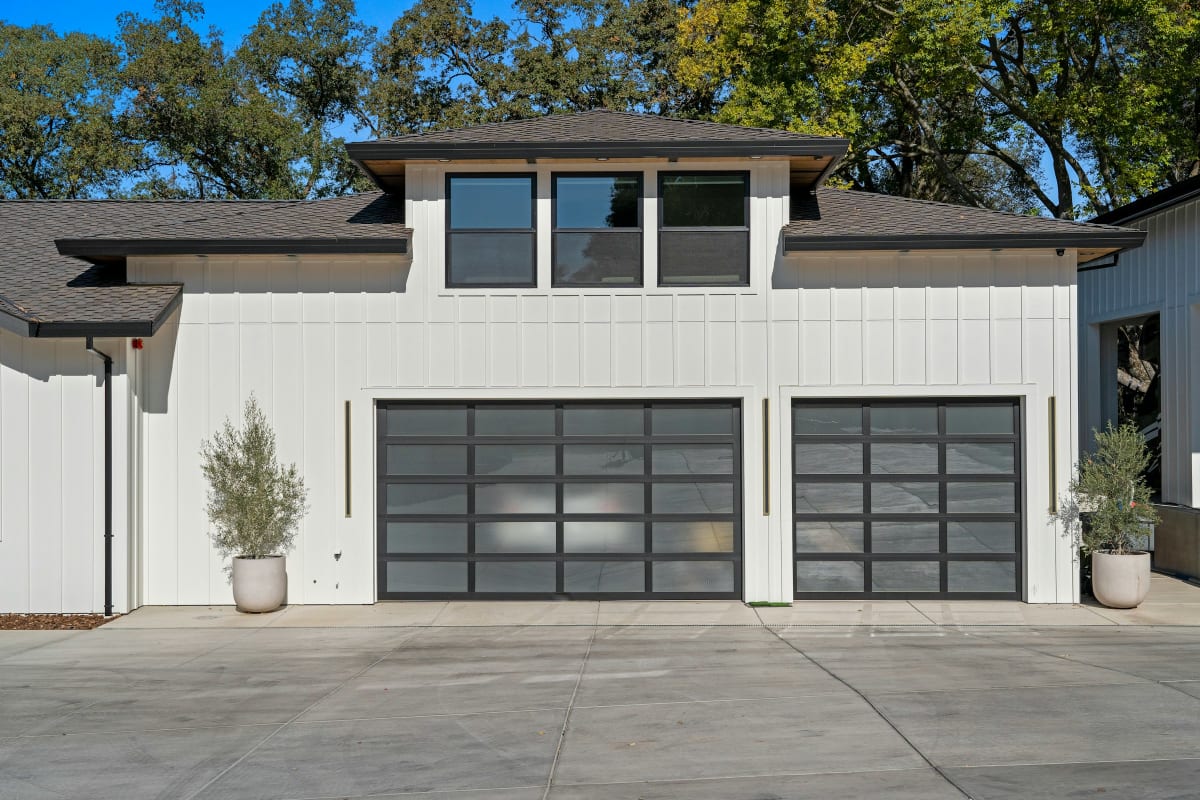
The Chamberlain side mount garage door opener is the RJO101, a wall mount that bolts beside the door, so there’s no rail or trolley overhead. It mounts on either side, frees the ceiling for storage or lights, and is the quietest opener Chamberlain makes. It has battery backup, built-in Wi-Fi for the myQ app, and an automatic lock that deadbolts the door every time it closes. You can add up to 8 remote LED light pods. The motor and the drive carry a lifetime warranty, with 5 years on parts.
Where it earns its place in Montana is the post-frame shop. The RJO101 handles a standard sectional door up to 14 feet high and 18 feet wide, up to 180 square feet, and high-lift track with up to 54 inches of lift. That’s the tall door a ceiling rail can’t serve without hanging in the way of a loft or a hoist.
Check the door before you buy, because every one of these has to be true:
| RJO101 requirement | Figure |
|---|---|
| Springs | Torsion springs on a 1-inch torsion bar; extension springs don’t work with it |
| Torsion bar past the bearing plate | At least 1-1/2 inches |
| Center of torsion bar to ceiling | 3 inches or more |
| Center of torsion bar to the wall it mounts on | 2-1/2 inches or more |
| End of torsion bar to side wall | At least 8-1/2 inches |
| Cable drums | 4 to 6 inches in diameter |
| Power | 120-volt outlet within 6 feet |
A door that misses any of them takes a rail-mounted opener instead. The RJO101 is a yellow learn-button opener, so its matching accessories are the 953EV and 956EV remotes and the 940EV keypad, and the CH363 works with it too.
Chamberlain keypads
A Chamberlain keypad mounts outside the door and opens it with a code, with no key and no remote. All of them run on a battery, so there’s no wire to pull. The Wireless Keypad CH348 is the one for Chamberlain, LiftMaster and most Craftsman openers made after 1997 with safety sensors, from the current white-button openers back to yellow, purple and orange or red. It lights up for night use, closes the door with one touch, and lets you set temporary PINs for guests. It’s built for all weather and rated to operate from -4°F to 149°F on one 9-volt battery. Put a fresh 9-volt in before winter; a tired battery quits in the cold first.
For another brand of opener, the Universal Wireless Keypad CHU48 fits most brands made after 1993 with safety sensors. On earlier yellow, purple, orange or red and green learn-button openers, the Wireless Keypad 940EV uses a four-digit code under a hinged cover, and the Original Clicker Universal Wireless Keypad KLIK2U works with over 90% of openers, with a backlit pad under a sliding cover. The myQ Smart Garage Video Keypad adds a camera with a 160-degree view and a separate PIN for each person, so you can see who opened the door. It’s IP55 rated and runs on a rechargeable battery.
To program a keypad to a current opener, press and release the opener’s LEARN button, enter a four-digit PIN of your choice on the keypad within 30 seconds, then press and hold ENTER until the opener lights blink or you hear two clicks. Starting from the wall control (lift the push bar, press LEARN twice) lets you use a PIN of 4 to 8 digits, finished with the HOME button. If a code has gotten around, hold the opener’s LEARN button about 6 seconds until its light goes out. That erases every remote and keypad, and you program each one back in with a new PIN.
Chamberlain myQ Smart Garage Control
The current Chamberlain openers have myQ built in. Chamberlain myQ Smart Garage Control (MYQ-G0401) is how you add the same phone control to an opener you already own. It works with most brands of opener made after 1993 that have standard safety sensors, including Chamberlain, LiftMaster and Craftsman from 1993 on and Genie and Overhead Door from 1996 on. It connects over Wi-Fi and Bluetooth, measures 2.6 inches square, and is rated from -4°F to 149°F. One unit runs two doors once you add the MYQ-G0402 door sensor for the second.
With the free myQ app you open and close the door from anywhere, get an alert when it opens, closes or has been left open, set a schedule to close it, and share access with up to five people. That’s worth having when the cabin is on Lake Koocanusa near Eureka and you’re at work in Kalispell, 66 miles away, wondering whether the door went down. Before you buy, stand in the garage with your phone: the setup wants a Wi-Fi signal of 75% or better there, and the openers themselves connect on 2.4 GHz.
Chamberlain battery backup and replacement batteries
Battery backup is the feature to buy in Montana. When the power goes out, an opener with battery backup keeps opening and closing the door. A fully charged battery gives up to 24 hours of normal operation and recharges in 24 hours once the power is back. In Great Falls, where winter gusts run 30 to 40 mph, and anywhere a heavy wet snow takes the lines down, that’s the difference between driving the truck out and lifting a cold door by hand. On battery the opener beeps every 2 seconds and may run a little slower, and the lights, the app and Timer-to-Close come back when the power does.
The Chamberlain door opener battery is part 4228, a 12-volt battery, and it lasts about 1 to 2 years. The opener tells you when it’s done: it beeps and the battery status light turns red. Replacing it is a screwdriver job. Unplug the opener, take off the side panel with a Phillips screwdriver, slide the battery in with the terminals facing out, connect red to positive and black to negative, put the cover back and plug the opener in. If the place sits empty for a season with the opener unplugged, disconnect the battery and it will last longer.
The remotes run on a 3-volt CR2032 coin cell: loosen the one captive screw, lift the top housing, swap the cell and close it up. The keypads take a 9-volt. The Wireless Wall Control CH125 also runs on a CR2032 with no wiring at all, and it’s rated down to -31°F, which suits the wall of an unheated garage.
Chamberlain garage door sensors and installation
The garage door sensors are the pair of small eyes at the bottom of the door opening, and a Chamberlain opener will not close the door unless they’re connected and aligned. Mount them so the beam is no higher than 6 inches off the floor. When they’re right, both lights glow steady: amber on the sending sensor, green on the receiving one. A blinking green light means something is in the beam or the sensors are out of line, so loosen the wing nut, aim until both lights are steady, and tighten it. If the receiving sensor looks into direct sun, swap the two sensors side for side. That one matters here in winter, when the sun sits low in the south and shines straight in under an open door. If a light is off altogether, look for a broken wire and check that white goes to the white terminal and white/black to the grey one. The replacement is Safety Sensor Kit 041-0136, with both sensors, wire, connectors and hardware, for openers made after 1997.
Installing a Chamberlain garage door opener takes 2 hours or more, with a second person for some steps, and common tools: hammer, screwdriver, wrench, drill, tape measure and wire cutters. Start with the door, not the opener. It has to be balanced and lubricated, and any spring or cable repair is a job for a trained door technician before the opener goes up. Hang the opener 7 feet or more above the floor, plug it into a grounded outlet and never an extension cord, and put the wall control in sight of the door at least 5 feet up.
Setting the travel takes three buttons on the side of the opener. Hold the adjustment button until the UP button flashes, run the door up to where you want it open and press the adjustment button, then run it down to closed and press it again. The opener sets its own force from there. Finish by laying a 2x4 flat on the floor under the door and closing it: the door must reverse when it touches the board. Run that test every month, and once a year put garage door lubricant on the rollers, bearings and hinges.
Why Chamberlain
Buy Chamberlain because one maker covers the whole garage and designs it for you to install: opener, remote, keypad, sensors and app. The current openers all have DC motors with soft start and stop and myQ built in. The top belt drives carry a 10-year warranty on motor and belt, and the wall-mount RJO101 carries a lifetime warranty on motor and drive. Battery backup that runs up to 24 hours is the answer to a Montana outage, and the remotes are rated to -13°F. The fit rules are simple enough to check in your own garage: learn-button color for the remote, door weight and use for the motor, and a tape measure for the wall mount.
Frequently Asked Questions
Are LiftMaster and Chamberlain the same company?
Yes, they’re two brands of one company. Chamberlain Group is the parent company of LiftMaster, Chamberlain and myQ, and Chamberlain is the line built for do-it-yourself installation. That shared parent is why Chamberlain remotes and keypads such as the CH363 and CH348 are made to work with LiftMaster openers as well.
How do you program a Chamberlain garage door opener remote?
On the current openers, press and release the LEARN button on the opener, and its light glows steady for 30 seconds. Press and hold the button on the remote until the opener lights blink or you hear two clicks, then press it again to test the door. You can also start from the wall control by lifting the push bar and pressing its LEARN button twice. On an older opener the LEARN button is under the light cover on the antenna side.
How do you reset a Chamberlain garage door opener?
Press and hold the LEARN button on the opener until its light goes out, about 6 seconds. That erases every remote and keypad code, and you program back the ones you want to keep. Holding the button a second time until the light goes out erases the myQ accessories too. To clear the opener’s Wi-Fi connection, hold the black adjustment button until you hear 3 beeps.
How do you change the battery in a Chamberlain garage door opener?
The backup battery in the opener is part 4228, a 12-volt battery, and the opener beeps and shows a red battery light when it needs one. Unplug the opener, remove the side panel with a Phillips screwdriver, slide in the new battery with the terminals facing out, connect red to positive and black to negative, replace the cover and plug it back in. A remote takes a 3-volt CR2032 coin cell behind one captive screw, and a keypad takes a 9-volt.
How do you install a Chamberlain garage door opener?
Plan on 2 hours or more and a helper for some steps, with a hammer, screwdriver, wrench, drill, tape measure and wire cutters. The door has to be balanced first, the opener hangs 7 feet or more above the floor, and the safety sensors mount with their beam no higher than 6 inches off the floor. Set the open and closed positions with the buttons on the opener, and it sets its own force. The job is finished when the door reverses off a 2x4 laid flat on the floor.
Which Chamberlain remote works with your garage door opener?
Go by the color of the opener’s LEARN button. A white button takes a Security+ 3.0 remote such as the CH363, the CH382 keychain or the CHU62 universal. Yellow, purple and orange or red buttons take the CH363 or the 953EV, and the Original Clicker KLIK5U handles two different brands of opener with green, orange or red, purple or yellow buttons.
Ready to Get Started?
Our doors & millwork specialists can help you find the right Chamberlain products for your project.